
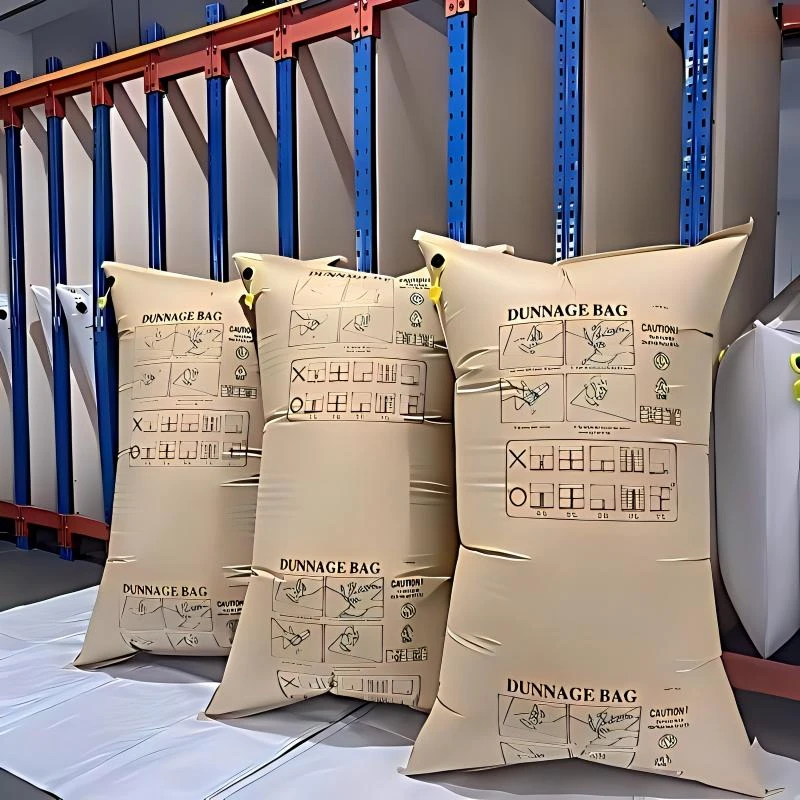
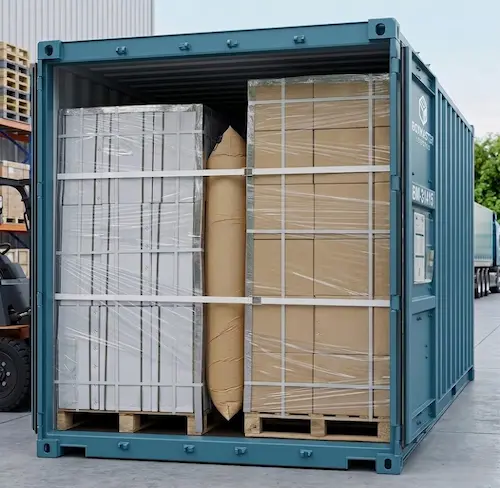
Dunnage airbags look simple to use: place the bag in the gap and inflate it. In practice, most problems come from choosing the wrong size, poor positioning, sharp pallet edges, or incorrect inflation.
If you are not sure which dunnage airbag to use, start with the void. Measure the gap, check the cargo surfaces on both sides, and look at where the bag will actually sit after inflation.
This guide covers the practical points that matter most when using dunnage airbags for cargo securing: size, contact area, placement, inflation pressure, and final inspection.
1. Start with the Void
Before choosing an airbag, look at the actual space between the cargo.
Check:
- void width;
- available height and length;
- cargo surfaces on both sides;
- pallet openings or overhang;
- sharp or rough surfaces;
- stability of the cargo.
If the void is uneven, measure it at more than one point. Do not rely on a single measurement.
For example, two loads may both have a 30 cm gap. One may have large, flat pallet faces on both sides, while the other has irregular crates or open pallet sections. The same airbag may not work equally well in both situations.
This is why we normally ask for void dimensions and a loading photo, not just the cargo weight.
2. Choose the Right Size and Check the Contact Area
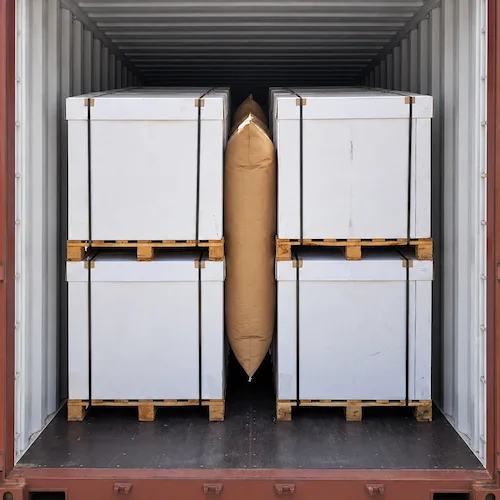
Tensipack dunnage airbags are available in common widths of 60, 90, 120 and 150 cm, with different lengths available for different loading arrangements.
The width of the bag should be selected according to the void, while the length should provide suitable coverage for the cargo surfaces it needs to support.
Don’t choose the bag by width alone. A 30 cm void does not automatically tell you which bag to use. You also need to consider the available height and the contact area between the inflated bag and the cargo.
The same airbag can have a different contact area depending on the size of the void. As the bag expands further into a larger gap, the way it contacts the cargo changes.
A bag that is too small may have too little contact with the load. Adding more air is not the solution. An oversized bag is not automatically better either.
The goal is to choose a bag that fits the void and provides good contact with stable cargo surfaces on both sides.
When asking us for a size recommendation, send:
Void Width × Available Height × Available Length
A loading photo is even better, especially for irregular loads. It can show pallet openings, uneven cargo surfaces, overhang, sharp edges and other details that dimensions alone may not show.
3. Position the Airbag Correctly
Position the cargo first, then place the uninflated airbag into the intended void.
Before inflation, make sure:
- the bag is not twisted or unintentionally folded;
- the valve is easy to reach;
- the cargo on both sides is stable;
- the bag has good contact with the cargo surfaces;
- there are no exposed nails, broken pallet edges or sharp corners;
- the bag will not rub directly against rough surfaces during transport.
Try to position the main body of the airbag against stable cargo surfaces rather than unsupported pallet openings or narrow projections.
If the bag may contact a sharp crate corner, broken pallet edge, exposed fastener or rough timber, place suitable protective material such as cardboard or edge protection between the airbag and the contact point. Avoiding sharp edges and maximizing surface contact are important placement principles because poor contact or abrasive surfaces can lead to airbag damage or poor load support.
The cargo should already be in its intended position before inflation. Do not use the airbag simply to push badly positioned cargo into place.
Also, Do not try to solve a large void simply by folding an unsuitable bag or adding more bags into the gap. Start with the right bag size and loading arrangement.
4. Check the Valve and Inflator
The valve may look like a small detail, but it matters during loading.
Before using the bag, make sure your dunnage airbag inflator is compatible with the valve.
The inflator should connect properly and allow the operator to control the airflow during inflation.
This becomes more important when a container requires several airbags. A good valve and inflator combination makes the loading process faster and easier to control.
If you are comparing dunnage airbags from different suppliers, check the valve type and inflator compatibility as well as the bag size, construction and pressure specification.
5. Inflate the Airbag Gradually
Once the bag is in the correct position, connect the inflator and start filling it gradually.
Watch the bag while it expands. Check that it:
- stays in the intended position;
- develops good contact with the cargo on both sides;
- does not become pinched or twisted;
- does not push the cargo out of position;
- does not press against a sharp or unsuitable surface.
If you notice a problem, stop inflation and correct the position before continuing.
Do not judge inflation only by how hard the bag feels.
Inflate according to the product and application requirements without exceeding the specified maximum filling pressure.
More pressure is not a solution for poor sizing or poor positioning.
If the shipment is expected to experience large temperature changes, this should also be considered because the pressure inside an inflated airbag can change as temperature changes.
6. Don’t Confuse Filling Pressure with Burst Pressure
This is one specification buyers often misunderstand.
Maximum Filling Pressure is the maximum pressure specified for inflating the bag. It does not mean that every bag should always be inflated to this pressure.
Maximum Burst Pressure is different. It indicates the bag’s burst-pressure performance under specified test conditions. It should not be treated as the target inflation pressure.
Tensipack dunnage airbags have the following pressure ratings:
| Level | Max. Filling Pressure | Max. Burst Pressure |
| Level 0 | 2 PSI | 6 PSI |
| Level 1 | 3 PSI | 8 PSI |
| Level 2 | 5.8 PSI | 17 PSI |
| Level 3 | 8.7 PSI | 25 PSI |
| Level 4 | 10 PSI | 30 PSI |
A higher pressure rating does not automatically mean that you need a higher-level bag. The correct level depends on the cargo, loading arrangement, void, transport conditions and other application requirements.
When comparing specifications from different suppliers, check what the PSI value actually refers to. Some suppliers may show working pressure, while others show maximum filling pressure or burst pressure. Do not compare two PSI values until you know they describe the same thing.
Maximum Filling Pressure ≠ Required Inflation Pressure ≠ Burst Pressure
7. Check the Airbag Before Closing the Container
After inflation, take another look before closing the container or vehicle.
Check that:
- the airbag is still in the intended position;
- it has good contact with stable cargo surfaces;
- the valve is properly closed;
- the bag is not pinched or visibly damaged;
- it is clear of nails, sharp edges and broken pallet parts;
- the cargo has not been pushed out of position;
- no significant uncontrolled void remains.
Don’t judge the installation only by how fully inflated the bag looks. Its position, contact area and surrounding surfaces should also be checked.
Dunnage airbags mainly provide void filling and load stabilization. They do not automatically replace other cargo securing methods.
If the load also requires restraint, composite strapping, lashing, blocking or bracing may be used as part of the overall securing arrangement.
For an example of using restraint and void filling together, see How to Combine Composite Strapping with Dunnage Airbags for Container Cargo Securing.
8. What Should You Send Us for a Dunnage Airbag Recommendation?
A common inquiry we receive is:
“My cargo weighs 10 tons. Which dunnage airbag should I use?”
Cargo weight is useful, but it is not enough to select the bag.
If possible, send us:
- cargo type and approximate weight;
- transport mode — container, truck, rail, etc.;
- void width, height and available length;
- pallet or cargo dimensions;
- a photo of the actual loading arrangement;
- current airbag size and level, if you already use one;
- pressure specification, if known;
- expected transport duration;
- significant temperature changes, if expected.
For irregular loads, a loading photo is especially useful because the same void width can result in very different contact areas depending on the cargo shape and pallet arrangement.
If you can only provide a few things, start with:
Void Dimensions + Loading Photo + Transport Mode
If you are already using dunnage airbags, tell us the current size, level and pressure specification as well.
This gives us a much clearer picture of the application than cargo weight alone and helps us recommend a suitable dunnage airbag for the actual loading arrangement.